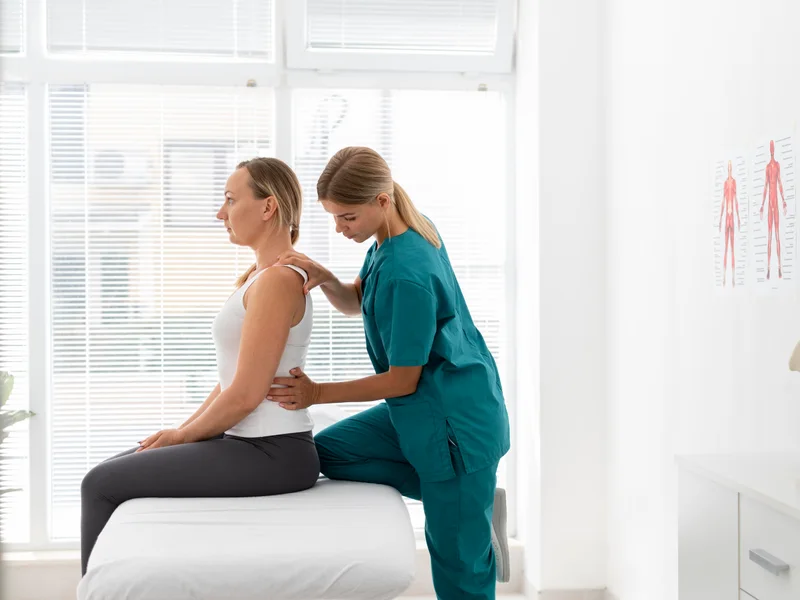
Intersegmental traction therapy in Burnsville, MN — a gentle motorized roller table that mobilizes the spine, eases stiffness, and warms up the joints before adjustments.
Eagle Trace Spine & Sport
Intersegmental Traction Therapy in Burnsville
Stiff, achy spines often move better with a little gentle motion. Intersegmental traction therapy at Eagle Trace Spine & Sport uses a motorized roller table to slowly stretch and mobilize your spine, one segment at a time. It's relaxing, completely passive, and a comfortable way to loosen up the back and neck — on its own or as a warm-up before an adjustment here in Burnsville.
What to expect with intersegmental traction therapy
Step 1
Confirm it fits your spine
Dr. Plaster reviews your history and exam findings to make sure gentle motorized traction is appropriate — and rules out the situations where a low-force roller table isn't the right tool.
Step 2
Relax on the roller table
You lie back while slow-moving rollers travel along your spine, gently mobilizing each segment. Sessions are comfortable, passive, and typically last only a few minutes with no downtime.
Step 3
Combine with care that lasts
We use intersegmental traction to warm up and loosen the spine alongside adjustments, decompression, and rehab — so the mobility you gain on the table carries into the rest of your plan.
Why patients choose it
Benefits of intersegmental traction therapy
Gentle, passive, and completely low-force
Encourages motion in stiff or restricted spinal joints
May improve circulation to discs and surrounding soft tissue
Helps relax tight muscles along the spine
A comfortable warm-up before chiropractic adjustments
No drugs, no needles, and no downtime
Pairs naturally with decompression and rehab
The basics
About intersegmental traction therapy
Intersegmental traction is a passive therapy delivered by a "roller table." You lie face-up on a padded surface while a set of rollers moves slowly up and down beneath you, following the natural curves of your spine. As each roller passes, it gently flexes and stretches the joints between your vertebrae — the intersegmental joints that give the therapy its name.
The slow, rhythmic motion is thought to encourage movement in stiff or restricted spinal joints, ease tight muscles, and improve circulation to the discs and soft tissues that surround the spine. Spinal discs rely on movement to draw in fluid and nutrients, so gentle mobilization may help keep them healthier. Most patients find the table deeply relaxing, and because it's passive and low-force, it often pairs naturally with chiropractic adjustments and decompression as part of a broader plan.
What is intersegmental traction therapy?
Intersegmental traction therapy is a gentle, passive treatment delivered by a motorized “roller table.” You lie back while a set of rollers moves slowly along the length of your spine, flexing and mobilizing each segment in turn. It’s used to encourage motion in stiff joints, relax tight muscles, and warm up the spine — drug-free and comfortable.
How it works
Your spine is made up of vertebrae stacked with small joints and cushioning discs between them. When those segments get stiff or restricted, the surrounding muscles tighten and the discs lose some of the gentle movement they rely on to stay healthy.
As you rest on the roller table, the rollers travel slowly up and down beneath you, following the natural curves of your back. Each pass produces a soft, rhythmic stretch that:
Mobilizes the spinal joints — the slow rolling motion is thought to coax stiff or restricted segments through a gentle range of movement.
Relaxes the surrounding muscles — the rhythmic stretch can help tight paraspinal muscles let go, easing the tension that often accompanies a stiff spine.
Encourages circulation to the discs — spinal discs draw in fluid and nutrients through movement, so gentle mobilization may support the soft tissues around the spine.
Because the table does the work for you, it’s often used to warm up and loosen the spine at the start of a visit — or as a soothing complement to other care.
What to expect during a session
There’s nothing to do but relax. You lie face-up on the padded table, and the rollers begin moving slowly along your spine. Most patients describe the sensation as a gentle, massage-like stretch that travels up and down the back — there’s no sharp pulling and no force. A typical session lasts only a few minutes, and there’s no downtime afterward, so you can drive yourself home and get on with your day.
At our Burnsville clinic, intersegmental traction is usually one part of a visit rather than the whole appointment. Dr. Jeff Plaster often uses it to loosen the spine before a chiropractic adjustment, so the joints move more freely when it’s time for hands-on care.
Conditions it can help
Intersegmental traction is most useful for spinal stiffness and as a complement to care for a range of mechanical spine problems, including:
It works best as a supporting therapy. For disc-related and nerve-compression problems, it’s commonly paired with spinal decompression, which targets a specific disc with computer-controlled traction, while the roller table provides broader, gentler mobilization across the whole spine.
Why choose Eagle Trace Spine & Sport
Patients from Burnsville, Savage, Apple Valley, Lakeville, and across the south metro choose us because we build complete, sensible plans instead of relying on any single tool. Dr. Jeff Plaster uses intersegmental traction where it fits — to loosen and prepare the spine — alongside chiropractic care, spinal decompression, and corrective care so you’re addressing both the stiffness and the mechanics behind it.
Curious whether a gentle roller-table session belongs in your plan? Visit our new patients page or contact us to schedule an evaluation in Burnsville.
What it helps
Conditions we treat with intersegmental traction therapy
Still have questions? Contact us — we're happy to help.
What is intersegmental traction therapy?+
It's a passive treatment using a motorized "roller table." You lie back while rollers move slowly along your spine, gently flexing and mobilizing each segment to encourage motion, relax muscles, and warm up the spine before or alongside adjustments.
What does the roller table feel like?+
Most patients find it relaxing — a slow, rolling stretch that travels up and down the back as you lie comfortably. There's no pulling or sharp pressure, and many people describe it as a gentle, soothing massage-like motion.
How long does a session take?+
Sessions are short, usually just a few minutes. Because intersegmental traction is passive and low-force, you simply rest on the table while it works. There's no downtime afterward, so you can return to your day right away.
Is intersegmental traction the same as spinal decompression?+
No. Decompression uses computer-controlled traction to create negative pressure inside a specific disc. A roller table instead provides broad, gentle mobilization across the whole spine. The two are often used together as part of one plan.
What conditions can a roller table help with?+
It's often used for general spinal stiffness, back pain, and neck pain, and as a complement to care for disc irritation or pinched nerves. It works best alongside adjustments and rehab rather than as a standalone fix.
Is roller table therapy safe?+
It's a gentle, low-force, non-invasive therapy that's well tolerated by most patients. Dr. Plaster screens for the few situations where motorized traction isn't appropriate during your exam, so it's only used when it's a good fit.
“Competent care, Dr Jeff listened to my issue and had a recommendation for my care. He even included a mode of care outside of his venue. In short, he really cares about my health.
And great, efficient staff.”
jtjim tikalskyVerified review · Google”
“After being in a car accident in December, I received a mailer from Dr. Plaster at Eagle Trace Chiropractic. I’d never sought chiropractic care after an accident before, but something told me to schedule an evaluation—and I’m so glad I did.
One of the things that immediately stood out was how thorough the initial appointment was. They took X-rays, and Dr. Plaster reviewed them with me right then and there. He explained exactly what he was seeing, where the problem areas were, and how they were contributing to the pain I had been living with—all in a way that was easy to understand without ever feeling overwhelming. His knowledge is incredibly impressive, but what really sets him apart is his ability to connect with people. You can tell he genuinely cares about every patient, and the fact that he’s learned multiple languages to better serve his community speaks volumes about the kind of person he is.
Since starting care at Eagle Trace, my body has done a complete 180. The chronic pain and tension in my neck and shoulders have improved more than I ever thought possible. I move better, I hurt less, and I honestly feel like I have a much better quality of life. It’s opened a door I didn’t even know existed.
My treatment plan was thoughtfully designed around my specific injuries and included adjustments, the rolling table, neck and lower back decompression, massage therapy, and SoftWave therapy. Every part of my care felt intentional, and every member of the team played an important role in my recovery.
The massage therapists are phenomenal, and the front desk staff are truly the heart of the office. They’re the same wonderful people who help with decompression treatments, and they’re always kind, welcoming, attentive, and encouraging. Every visit feels personal because they genuinely care about how you’re doing. They also went above and beyond to help me navigate my auto insurance claim, making sure I understood my coverage and handling so much of the process. They even offered to connect me with an attorney if I ran into issues with insurance. Knowing they were advocating for me took so much stress off my shoulders. They also have very reasonable self-pay rates, making exceptional care accessible.
I walked into Eagle Trace unsure whether chiropractic care would really make a difference for me. Today, I’m a firm believer because of the life-changing care I’ve received from Dr. Plaster and his incredible team. If you’ve been in a car accident—or you’re simply living with chronic pain—I cannot recommend Eagle Trace Chiropractic highly enough.”
ABAnna BatzVerified review · Google”
“Very nice facilities, the girls in front excellent, they really are. Dr Jeff Plaster, great guy, polite, and very professional and very thorough, he will explain every thing to you. then he will crack your back and neck , he has a good touch. and you will start to feel good. then you go to the rollers. Love them . the rollers really complete the experience. love them. All in all , its a good experience to get your adjustment for the back . I would say
it's a 5 star experience. Thank you All.”